What is EMC Testing?
What is EMC Testing?
In the world of electronic engineering, EMC (Electromagnetic Compatibility) testing is the process of evaluating whether a device can function “harmoniously” and “resiliently” within its electromagnetic environment.
Simply put, EMC testing has two core objectives:
- EMI (Electromagnetic Interference): Ensuring your device doesn’t produce excessive noise that disrupts radios, Wi-Fi, or other sensitive electronics.
- EMS (Electromagnetic Susceptibility/Immunity): Ensuring your device can withstand external interference—such as static electricity, lightning surges, or nearby mobile signals—without crashing or malfunctioning.
Key Categories of EMC Testing
EMC testing is generally divided into four quadrants, covering the path of disturbance (Conducted vs. Radiated) and the direction of the disturbance (Emission vs. Immunity).
1. EMI (Emission) — The “Offensive” Side
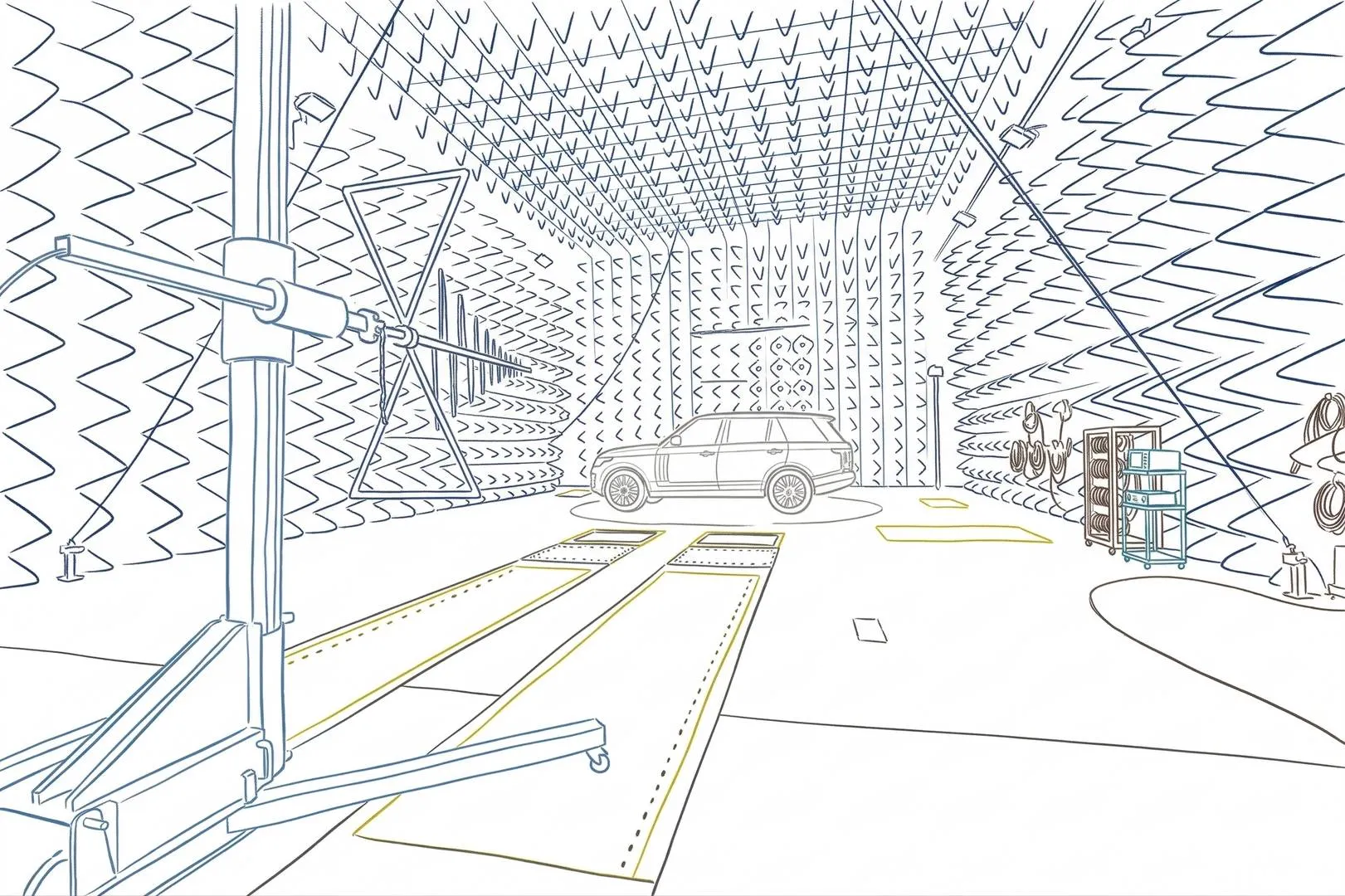
- RE (Radiated Emission): Measures the intensity of electromagnetic waves radiated through space. This is typically done in an anechoic chamber.
- CE (Conducted Emission): Measures the noise feedback from the device into the power grid or signal lines. This is a primary focus of our Limits Module.
2. EMS (Immunity) — The “Defensive” Side
- ESD (Electrostatic Discharge): Simulates static electricity from a human body striking the device (e.g., IEC 61000-4-2).
- Surge: Simulates transient high-voltage shocks caused by lightning on the power grid.
- RS (Radiated Susceptibility): Tests the device’s survival in strong electromagnetic fields, such as those near radio towers.
Core Testing Equipment and Environments
To achieve accurate and repeatable results, EMC testing must take place in controlled laboratory settings:
- Anechoic Chamber: A shielded room lined with radiation-absorbent material (RAM) to simulate a free-space environment by eliminating reflections.
- LISN (Line Impedance Stabilization Network): Used in conducted emission tests to provide a stable impedance between the power source and the device under test (EUT).
- Spectrum Analyzers/Receivers: Precision instruments that capture the amplitude and frequency of electromagnetic waves to determine if they exceed limits set by standards like CISPR.
Why is EMC Testing So Important?
If you want to sell your product globally, EMC testing is a legal mandate:
- CE Marking (EU): Requires both EMI and EMS compliance.
- FCC Certification (USA): Primarily restricts EMI (Emission) to keep the radio spectrum clean.
- VCCI (Japan): Emission limits for Information Technology Equipment (ITE).
Products that bypass EMC testing risk heavy fines, recalls, and high failure rates in real-world environments due to static or interference.